Page text
Proofreading Strategy
-Refer to the instructions of the task first
-Start with the easy stuff
-Build a model of the cell in your head
-Locate problem areas
-Attempt the hard areas
-Ask for help
-Tag and move on
-Trust the process
Recreation from source (11 pages) — rendered images with extracted text. Editable original via the source link above.
Proofreading Strategy -Refer to the instructions of the task first -Start with the easy stuff -Build a model of the cell in your head -Locate problem areas -Attempt the hard areas -Ask for help -Tag and move on -Trust the process
What is a Task
-Every task has three distinct parts: Beginning, Middle, and End
-In the beginning the instructor gives the task, the goal, and suggests the process and workflow
-In the middle we refine and elaborate the parameters of that goal, adjust the process to suit its
needs, and give feedback to the instructor
-During the End the goal parameters are well defined, the task workflow is established, and
continues until it’s finished
-The most important parts are the Beginning and Middle. These are pillars that set us up for
success in the End when we finish the task. Be sure to ask a lot of questions so you know how
best to apply your skills to the task at hand.
-New task arrives
Refer to the Instructions of the Task First
*For example: Sometimes they want speed
over accuracy, or vice versa.
**For example: If the goal is to find somas
tailor your method to suit the optimal
outcome
***For example: During a proofreading task
tags will be slightly different, how detailed
you need to be will be different, and the types
of errors you’ll encounter, etc.
-Take into consideration what the instructor of
the task is interested in accomplishing*
-When you are proofreading keep in mind the
goal of the task and divide it into parts**
-As you are proofreading there will be some
general guidelines the instructor lays out that
should be adhered to during your
proofreading***
-Once you have a rough outline of how the
task should be completed then you can
create a personalized plan to suit your style
of proofreading
Example Task
The instructor wants the list of 1000 cells proofread and is interested in any cells
with strange morphology or cells that innervate into the CB. They want it done as
fast as possible and aren’t concerned with missed branches under 6 nanometers.
Mergers should be removed if they are over 6 nanometers. The sheet has three
columns for your input: Status,Central Brain, and Notes. The tags are for Status
are: Done, Can’t Fix, Need 2nd Opinion. The tags for Central Brain are: Yes, No.
The notes column is for weird morphologies or to describe the Need 2nd Opinion
tag.
Example Task
The instructor wants the list of 1000 cells proofread and is interested in any cells
with strange morphology or cells that innervate into the CB. They want it done as
fast as possible and aren’t concerned with missed branches under 6 nanometers.
Mergers should be removed if they are over 6 nanometers. The sheet has three
columns for your input: Status,Central Brain, and Notes. The tags are for Status
are: Done, Can’t Fix, Need 2nd Opinion. The tags for Central Brain are: Yes, No.
The notes column is for weird morphologies or to describe the Need 2nd Opinion
tag.
-What are cells with normal morphologies?
-What is the time limit if any per cell?
-What qualifies as Can’t Fix?
-What qualifies as Done?
-What is the Need 2nd Opinion for?
-Where is the CB and how much of an
innervation is important?
-What if it’s in the CB but not anywhere else?
What are some questions you would ask about this task
before you start?
-How do I measure nanometers of mergers and
branches?
-What if a large branch is made of many smaller
branches that don’t meet the nanometer
standard?
-What if we can’t find the soma can it still be
labeled done?
-What if it had dendrites in the CB but not axons
or vice versa?
-What is your estimated timeline?
-Where is the list of cells?
Start With the Easy Stuff and
Build a Model of the Cell in Your Head
-When you begin tracing and you’ve never seen the cell type before start clicking around and get
a feel for what the structure looks like.
-Find the axonal parts (if they are present) and the dendritic parts (if they are present) and begin
imagining where the soma might be. (if it isn’t there, if it is that’s a great start!)
-Toggle the brain mesh on/off (if it’s available) and get an idea of where this cell sits in relation to
other cells you’ve proofread.
-Begin by investigating to the termination points of the cell’s neurites and look for obvious missed
branches that were disrupted by some type of error. (start with large backbones and bigger
morphological features)
-Get as many easy branches as you can while mentally noting the areas you want to come back
to.
Locate Problem Areas
Attempt the Hard Areas
-When you are tracing you will run across errors that can bog down your pace and
disrupt the flow of proofreading.
-Recognise a tough area for what it is and annotate it or remember where it is to come
back to once you’ve harvested all the easy segments you can get.
-If you are feeling up to the challenge or if after a quick inspection you recognise the level
of difficulty is manageable then feel free to solve the issue.
-Once a cell is filled out with all the easy stuff usually it’s 80-90% finished at this point.
-To get the last 10-20% is going to require you to make the plunge into the tough areas
and really give it your all. They aren’t easy but that’s what makes it all the more
rewarding when you locate a large branch that was trapped behind a terrible data error.
Ask for Help
Tag and Move on
When all else fails your best option is going to be your colleagues. I can’t tell you
how many times the other proofreaders have helped me find a segment that I
couldn’t locate and I for them. There really is some kind of fatigue that happens
when you get stuck in an area for a while. Try to recognise this feeling and make
sure to trust your gut and ask for help. On the same token you want to make sure
you give it an honest try before asking for help as well. When you receive help
next time someone is looking for help try to step up and give them an assist. Worst
comes to worst and neither person(s) can find the continuation then it’s always
acceptable to tag it and move on. Remember that your time is valuable!
Trust the Process
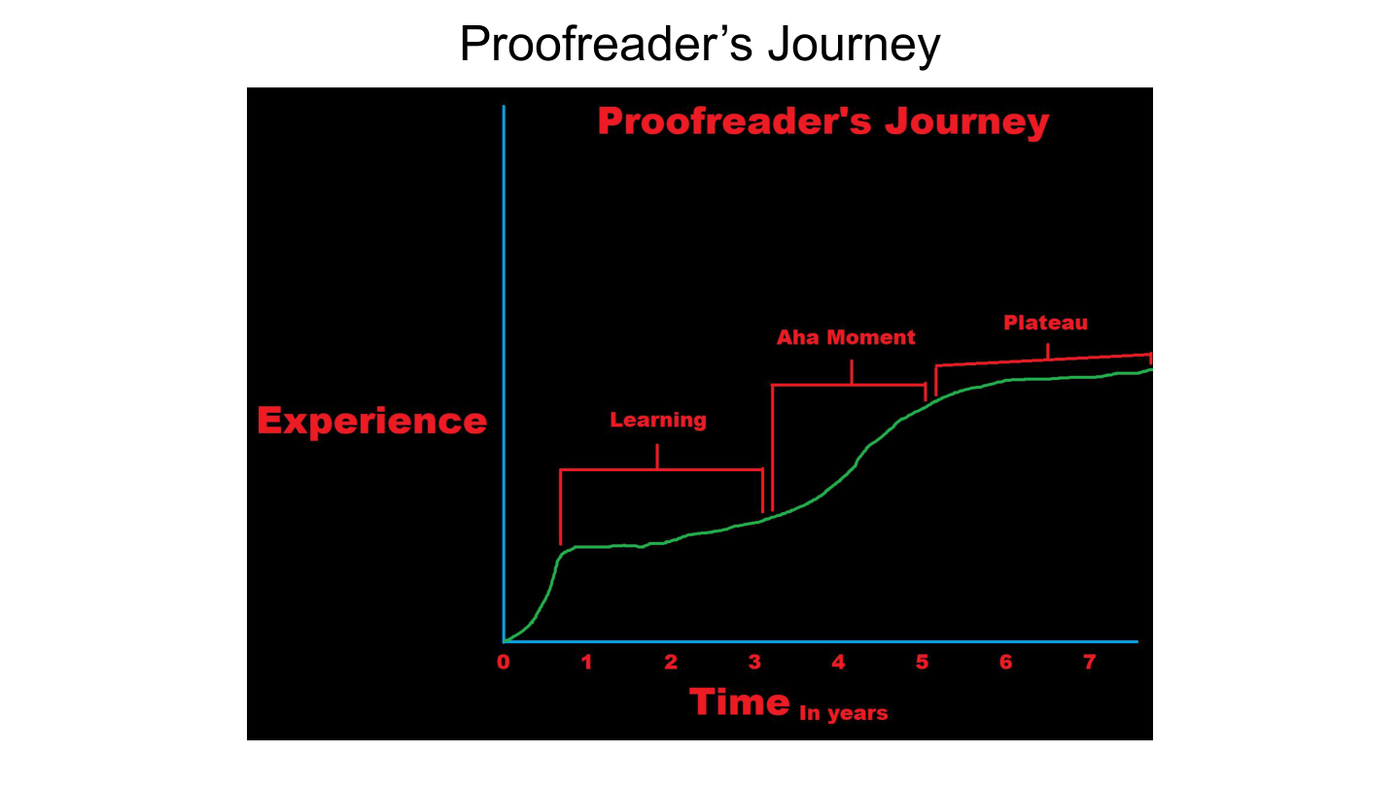
Proofreading isn’t easy and it can take a while before you feel confident in your
skills. I always say it takes about six months to two years before you can really
start to trust yourself. It varies from person to person and each individual will be
better at certain tasks than others. Give it some time and try to come up with your
own personal way to evaluate yourself. Make little goals here and there as a way
to feel the small wins. Keep a journal of the tasks you do and any notes or things
that stand out to you. Over time the journal will fill up with little bits of information
and history that you can look back on as proof of your personal progress. There
are times when proofreading can feel overwhelmingly difficult. Especially with the
BANC dataset! Remember to take care of yourself. Stand up every now and then,
stretch your legs, get some water or coffee or tea and focus back up when you're
ready.
Proofreader’s Journey